Music education is an essential part of life at The Children’s Trust School. Our provision is grounded in the belief that everyone is musical, and that every child and young person should be able to access, experience and make music in a way that is meaningful to them.
As the first recipient of the Sounds of Intent Gold Inclusive Music Education Award in the UK, we are proud of the quality, ambition and impact of our inclusive music provision. Music is delivered from our dedicated Music Hub by specialist Sounds of Intent practitioners, with a strong focus on access, musical development, communication, creativity, wellbeing and collaborative music-making.
Our work is rooted in inclusive practice. For us, inclusion in music goes beyond adapting an instrument or simplifying an activity. It is about processing time, pace, space, sensory access, positioning, personal choices thus giving young people genuine control over how they access and participate in music-making. We work to remove barriers so that every learner can make choices, take part, develop their musical voice and experience themselves as a musician.
Our approach
Creating music with children and young people with Profound and Multiple Learning Disabilities, complex health needs and acquired brain injury requires specialist practice. Practitioners need to rethink traditional approaches to communication, lesson design, musical interaction, assessment and progression.
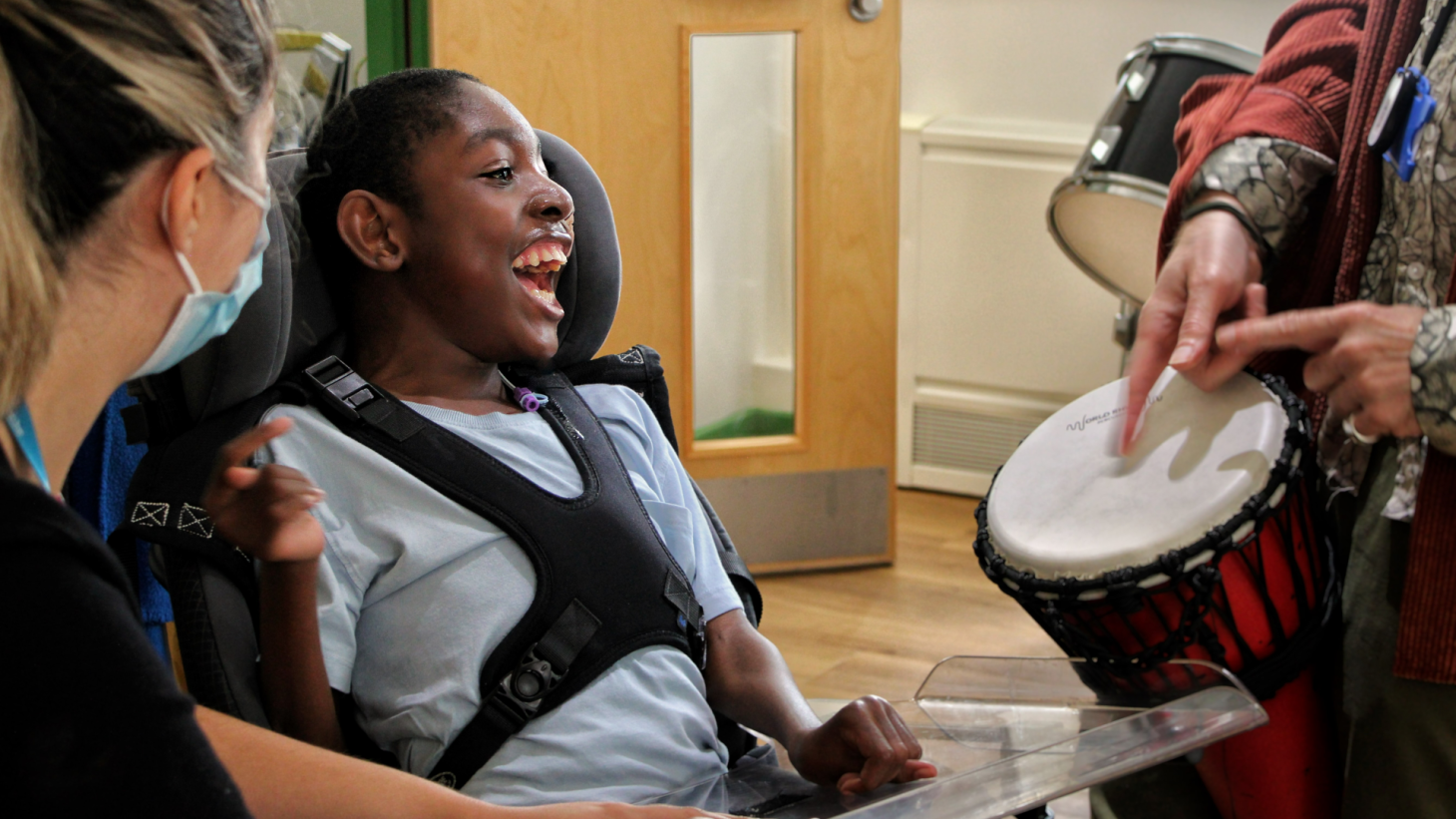
Our sessions are carefully designed around each learner’s access needs, sensory profile, communication style, physical presentation, preferences and stage of musical development. This may involve real and virtual instruments, adapted playing techniques, iPads, switches, microphones, resonance, vibration, assistive technology and other creative approaches that enable engaging music-making.
Learners are offered a wide range of musical experiences, including instrumental exploration, vocal work, listening, improvisation, composition, ensemble playing and immersion in different genres and musical cultures. These experiences support pupils to develop musical skills over time, while also strengthening communication, confidence and agency.
Musical engagement can be seen in many forms, from stilling, turning towards a sound, vocalising, smiling, showing anticipation or responding to silence, through to intentional sound-making, creating and controlling sounds, ensemble playing, improvisation, composition and formal accreditation. With the right access, support and opportunities, learners can continue to develop their musical skills over time, and each response is valued as part of a continuous musical journey.
Sounds of Intent and individualised teaching and learning
Our music curriculum is underpinned by the Sounds of Intent framework. Sounds of Intent is an inclusive musical development framework that maps how people engage with music across three domains:
- Reactive: listening and responding to sound and music
- Proactive: creating and controlling sounds
- Interactive: connecting and interacting with others through sound and music
The framework is non-genre specific and can be used to support people of any age, mapping musical development from childhood through to adulthood. This makes it especially relevant for our learners, as it allows progress to be recognised in small, meaningful and developmentally appropriate steps.
Every learner’s musical journey begins with a Sounds of Intent baseline. From this baseline, personalised music targets are set and reviewed. These targets guide planning, support progression and ensure that each learner is offered motivating, achievable and purposeful musical opportunities to develop their musical skills.
Evidence of progress is gathered through observation, video, photographs, professional discussion and weekly review. We look carefully at each learner’s responses, including subtle changes in attention, body movement, vocalisation, anticipation, interaction, choice-making and intentional sound-making. This enables staff to plan next steps and ensure that musical learning remains personalised, ambitious and responsive to each young person’s development.
Accessible instruments and music technology
Music technology plays a central role in our provision. We use technology not simply to provide access, but to remove barriers to musicianship for learners who may face significant physical, sensory, cognitive or communication challenges.
Young people may access music through real and virtual instruments, adapted keyboards, touch screens, switches, music apps, microphones, effects, accessible controllers. These resources allow learners to explore pitch, tempo, dynamics, timbre, texture, duration, rhythm and silence in ways that are physically accessible, meaningful and developmentally appropriate.
We are particularly interested in how innovative and adaptive technology can give young people real musical agency. This includes the ability to play with others, control musical effects, start and stop loops and phrases, lead an interaction, contribute to an ensemble and shape a piece of music over time.
Multi-sensory musical engagement
Many of our learners experience the world in highly sensory ways. Our music sessions therefore include a wide range of multi-sensory approaches, including sound, vibration, movement, visual cues, touch-based exploration of instruments and sound sources, repetition, anticipation, silence and carefully paced musical interaction.
Sessions may include listening activities, instrumental exploration, vocal work, resonance-based activities, call and response, turn-taking, group performance, improvisation, composition, music and movement, or sensory music stories. These approaches support musical development while also creating opportunities for communication, emotional regulation, shared attention, body awareness, confidence and wellbeing.
We recognise that each young person’s musical responses may be subtle, delayed or highly individual. Staff therefore allow processing time and use relationship-based knowledge to interpret responses carefully and respectfully. This helps ensure that each young person’s contribution is noticed, valued and built upon.
Collaborative music-making
Recognising music as a powerful tool for social bonding and cohesion, we champion the experience of making music together. In addition to their timetabled weekly music lessons, our learners have opportunities to take part in lunchtime music clubs, ensemble performances during festivals and collaborative projects, enabling them to contribute and feel part of a musical community
Our Sixth Form band, CedarSuperSound, provides an important platform for inclusive ensemble work and student-led creativity. The band enables young people to explore covers, original material, accessible performance and collaborative composition using a combination of live instruments, assistive technology and adapted approaches.
Through CedarSuperSound and wider school music projects, learners are supported to express identity, preference, creativity and musical agency. These projects also help raise aspirations around what inclusive performance can look and sound like.
Music and rehabilitation
Music also forms part of our enrichment offer for children and young people accessing rehabilitation. Weekly group music sessions provide opportunities for musical exploration, self-expression, enjoyment and connection at a time when many young people are adjusting to significant change.
These sessions differ in purpose and structure from our school-based music education provision. They are not formally assessed and are designed primarily to support wellbeing, emotional regulation, social connection and aspects of physical rehabilitation.
The sessions are flexible and may involve exploring familiar songs, instrumental play, accessible technology, improvisation, listening, and shared musical moments with peers, staff and family members. The focus is on meaningful and enjoyable engagement, with no performance expectations or pressure.
For some young people, music can reconnect them with interests and abilities they had before injury. For others, it may offer a new way to communicate, express emotion, experience control or take part in a new and enjoyable activity.
Sessions are typically group-based, not ability-dependent and they offer:
- A motivating space for musical interaction and expression
- Cognitive and physical stimulation through music
- Opportunities for emotional processing
- Engagement with real or virtual instruments to support motor skills
- Moments of joy, playfulness and social connection in a communal setting
In keeping with our wider inclusive ethos, accessibility, choice-making and agency are central to these sessions, allowing each young person to engage in a way that feels meaningful and comfortable for them.
The rehabilitation music offer has been recognised positively through external review, with the quality of the provision described as “exceptional”. In 2026, Franz Allard and Scott Harris also received a Pearson National Teaching Awards Bronze Award in the Unsung Heroes category, recognising their work in inclusive music education and rehabilitation music provision. This reflects the wider impact of the school’s approach and its commitment to meaningful, high-quality music-making for children and young people across education and rehabilitation.
Accreditation and recognition
Since 2024, The Children’s Trust School has been a Trinity College London validated course provider for the Awards and Certificates in Musical Development. This gives our learners access to recognised musical accreditation that is appropriate to their musical development and mode of engagement.
Since then, learners have successfully achieved Entry Level Awards in Musical Development, with outcomes to date awarded at Merit. External moderation recognised the school’s clear observations, accurate interpretation and strong understanding of each young musician’s current stage of musical development.
This accreditation pathway is important because it recognises musical achievement in a way that is meaningful, inclusive and rigorous. It allows young people with complex needs to have their musical development formally acknowledged, while also supporting high-quality assessment and reflective practice across the music team.
Partnerships and cultural experiences
We recognise that excellent music education is strengthened through partnership. Over time, we have worked with a range of organisations, artists and practitioners who have helped extend the musical and cultural experiences available to our learners.
Our collaborations have included Drake Music, the late musician and educator Graham Dowdall, Trinity College London, Sounds of Intent, Professor Adam Ockelford and Sophie Gray through Music for the Brain, Resonant Tails, TiME, Surrey Music Hub, Music Mark, the Royal Ballet and Opera, visiting musicians and performers, and other schools seeking to develop inclusive music practice.
Our ongoing development work includes exploring new technologies and accessible instruments through projects such as the Mugo Advisory Board and IRISBOND eye-tracking initiatives. These projects support our wider aim of advocating for inclusive music education, breaking down barriers to music-making, and enabling more young people to develop musical skills and agency through technology.
Through this work, our young people have accessed live performance, creative workshops, inclusive festivals, enrichment weeks, artist visits and collaborative projects. These experiences support cultural capital, curiosity, social connection and a sense of belonging.
We also share our own practice beyond the school, including outreach support, training and professional dialogue with other settings. As our provision continues to develop, we remain committed to contributing to the wider field of inclusive music education and learning from others who are working to make the arts more accessible.
Impact
The impact of music education at The Children’s Trust School can be seen in the musical, communicative, social and emotional development of our learners.
Through music, young people are supported to:
- listen, attend and respond to sound
- anticipate familiar musical routines
- make choices and show preferences
- create, control and organise sounds
- develop musical skills, confidence and agency
- communicate through vocalisation, gesture, movement or technology
- interact musically with peers and adults
- take part in ensemble music-making
- perform, improvise and compose where appropriate
- experience enjoyment, wellbeing and shared achievement
- work towards recognised musical accreditation where appropriate
Music gives our learners opportunities to be heard, to make choices, to take control, to connect with others and to participate in a rich cultural life. At The Children’s Trust School, we continue to develop a music provision that is inclusive, meaningful, ambitious and responsive to every young person’s musical potential.